

Mark and Cynthia were lean when they got married at 25. Twenty years later, they weren’t so lean. In fact, Cynthia needed a knee replacement from significant stress that the extra weight exerted on her knee joints. Mark needed a hip replacement for the same reason.
They knew they needed to lose weight but didn’t understand weight loss science or where to start. So, they did what most people do who need some information and fired up their browser. They searched for “most effective ways to lose weight fast.” They saw the search results shown in the screenshot below. They were a myriad of injections (that cost thousands of dollars), some supplements from Amazon that promise to “shred fat while you sleep,” some articles that claimed you will “shred” belly fat in 10 minutes a day with a specific set of exercises, and some other gimmick-sounding offers that promise you’ll lose weight fast.
They settled on the Keto diet. It sounded good – eat all the meat and cheese you want, but no bread and other carbs. Because carbs are bad for you and make you fat!
Three years later, they were heavier than when they started. And very frustrated.

Where Did Mark and Cynthia Go Wrong?
Like many other people who want to shed some pounds, they were confronted with a ton of options. Unfortunately, most of the “options” were gimmicks designed to move your money from your bank account to a company’s bank account. And they looked for things that promised fast results.
The rest of this blog explains scientific evidence-based facts about weight loss (and weight gain). Let’s think about Tom in Part 1. He knew he had to lose weight, but had no idea where to start. And then Amy in Part 2 didn’t know how to set a SMART goal for losing weight. She quit trying because she had unrealistic expectations about weight loss. And how many times have you heard the statement ‘I’m going to eliminate carbs because they are bad for you?” But ARE carbs bad for you, and do they make you fat? Let’s find out (spoiler alert: they aren’t and don’t).
Weight Loss Science
To help you avoid the pitfalls of marketing campaigns, this post explains the evidence-based science behind losing weight. You’ll find that the science isn’t that difficult. In fact, the science of weight loss is quite simple. It “only” takes a lifestyle change.
And therein lies the difficulty for most of us. Because it’s hard to change our lifestyles. But I help you with that in Part 5 (Create a Weight Loss/Maintenance Kitchen Pantry) and Part 6 (Modify Your Diet – but Not Drastically). Let’s look at the science, because a little understanding based on evidence and science will help you succeed in your weight loss journey. You’ll find losing weight is not as complicated as some companies and “influencers” want you to believe. Stick with me on this, and you’ll know what you need to do to lose weight.
The Energy Balance
Weight loss comes down to the Energy Balance. For our purposes, the Energy Balance includes three components that we do almost continually every day. We:
- Use (or burn) energy,
- Consume energy, and
- Store energy.
When it comes to our bodies, energy is measured in terms of calories. It’s likely that you’ve heard the word “calorie.” The calorie is a measure of energy. Just like a water bottle can hold a “quart” of water, a banana contains about 120 “calories” of energy. When we “consume” a banana, we consume 120 calories of energy.
Similarly, when we do any activity like walking, cleaning the house, and even breathing and pumping blood through our bodies, we burn energy. Our body is excellent at pulling energy that has been stored in our bodies for these activities. For example, if we go for a moderate-paced walk, we burn somewhere between 4 and 8 calories per minute. If we instead jog around the neighborhood, we burn 10 to 15 calories per minute, depending on how fast we run. The more intense the activity, the more calories we burn.
Finally, we can store energy if we don’t need it right now. For example, if you consumed a large breakfast and then sat around the rest of the day, some of those calories were stored in your body. And most likely, they were stored as fat for later use.
The Three Energy Components Must Balance
These three components have to balance each other in the following way:
(The energy we eat and drink) – (The energy we use or burn) = (The energy we store)
This principle has been around a long time. James Prescott Joule is considered the first person to discover the energy balance. He published his work in 1843. Since then, it has been used to design and develop refrigeration and heating systems, power plants, car and truck engines, aircraft, and almost everything we use in our lives.
This same energy balance principle has been applied to our bodies to understand what happens when we consume, burn, and store energy. Unfortunately for most of us, the energy we store is in the form of fat. If we consistently eat and drink more energy (i.e., calories) than we burn, we store the excess as mostly fat. To lose that excess fat, we must eat and drink fewer calories than we burn. That’s called a calorie deficit. In a calorie deficit, our bodies pull stored energy (i.e., mostly fat) out of storage and use that to power our bodies.
And it’s as simple as that.
A Simple Weight LOSS Example
Let’s say you want to lose 10 pounds and you burn about 2,500 calories per day (more on the 2,500 calories later). If you only ate and drank 2,000 calories a day, then the left side of the above energy balance would be:
(2,000 calories) – (2,500 calories) = -500 calories
The negative 500 calories is the amount your body will pull out of your fat stores to balance the equation. Because a pound of stored fat contains about 3,500 calories, that 500 calories represents about one seventh of a pound, or about 0.15 pounds of fat. In other words, we’d lose about 0.15 pounds that day and we would have to maintain the 500 calorie deficit for about a week to lose a pound of fat:
7 days x 0.15 pounds per day = 1.05 pounds
I get it – that’s not very much. But that’s the point. You didn’t gain that 10 pounds overnight, and you shouldn’t expect to lose it overnight. Creating a modest 500-calorie deficit will take about 70 days to lose that 10 pounds:
10 pounds divided by 0.15 pounds per day = 70 days
A Simple Weight GAIN Example
Now, let’s say you regularly consume 2,500 calories and you burn 2,000 calories per day. The energy balance is:
(2,500 calories CONSUMED) – (2,000 calories BURNED) = +500 calories
This time our body moves into storage mode. The extra 500 calories are stored in our bodies, most likely as fat. And you now know that this only amounts to 0.15 pounds a day. That’s not enough to notice on a given day, but after a couple of months, you will likely notice your clothes are a little tighter fitting.
This is how weight gain sneaks up on us. Unless you chow down all day long, it takes a long time to gain that extra 10, 20, or 50 pounds.
Let’s dive into how we burn and consume calories. But first, a cautionary message on trying to lose weight too fast.
Why Not Create a Huge Calorie Deficit to Speed Up Weight Loss?
After seeing how long it takes to lose a modest 10 pounds, you might be tempted to use this weight loss science concept to force yourself into a much larger calorie deficit. But the general consensus from reputable sources suggest a 500 to 750 calorie deficit is safe.
If you create a deficit much larger than the suggested 500-750 calories, then unhealthy things can happen. According to Cleveland Clinic, you can begin to suffer from one or more of the following side effects:
- Loss of muscle mass
- Fatigue
- Nausea
- Dehydration
- Constipation
- Headaches
- Crabiness
- Slower metabolism (that conserves the energy stores you have)
None of those are pleasant, and some (dehydration) can harm your body. And part of our goal should be to preserve the muscle mass we have, not lose that as part of our weight loss program.
Using (Burning) Energy
We’ll focus on two ways we burn energy:
- Maintaining our body by breathing, pumping blood, fighting off diseases, etc. Everything that doesn’t fall into the second category. This is referred to as your Resting Metabolic Rate (RMR)
- Physical activity – walking, running, exercising, house cleaning and yard work, or a physically-demanding job (construction for example) all burn energy. This is your Physical Activity Metabolic Rate (PAMR), which will also include your RMR.
Resting Metabolic Rate - Burning Energy at Rest
This is one of the pillars of weight loss science. Our bodies are living organisms that do things. Among those things, they repair themselves, fight off viruses and bacteria, grow, learn, make decisions, digest food, and move. Doing these things takes energy. For example, lifting your hand takes energy – muscle fibers have to contract somewhere in your arm and shoulder to lift your hand. Every time a muscle fiber contracts, it uses some energy.
We don’t have to move to use energy. You can sit on the couch watching TV all day and still burn energy/calories. Your heart still has to beat, muscles have to inhale and exhale air, you might be thinking, and you are likely moving around the house a bit. Your immune system might be fighting a battle with a virus that’s trying to invade your body. We do these things all the time. It’s called our Resting Metabolic Rate (RMR). The word Resting means just that. We’re not actively doing anything except maybe walking to another room in the house. Researchers have found that the RMR depends on age, weight, height, and whether we’re male or female.
Estimating our Resting Metabolic Rate
So… how do we calculate our personal RMR? Measured RMR data from multiple individuals in a lab setting were used to develop mathematical models. This was first done in 1918 by Harris and Benedict. The equation has been updated and revised over the years to include various ages, body weights and heights, and whether you’re a female or male. It has been updated over the years, the latest being in 2023. Four researchers published a revised Harris-Benedict equation in the NIH’s National Library of Medicine to account for the modern state of the human population (maybe a little heavier) instead of what the population was like in 1918.
We’ll use the latest iteration of the RMR equation, although the differences are not that great. The revised RMR can be calculated with one of the following four equations (one for men and one for women, and then one each for metric or English units):
| Men Metric Version | (9.65 x Weight in Kilograms) + (573 x Height in meters) - (4.7 x Age in Years) + 260 |
| Men English Version | (4.38 x Weight in Pounds) + (14.55 x Height in Inches) - (4.7 x Age in Years) +260 |
| Women Metric Version | (7.38 x Weight in Kilograms) + (607 x Height in meters) - (2.31 x Age in Years) + 43 |
| Women English Version | (3.35 x Weight in Pounds) + (15.42 x Height in Inches) - (2.31 x Age in Years) +43 |
You might notice that the equation is separated into four terms: one each for weight, height, age, and a constant number. The height and weight terms add to the RMR and the age term decreases the RMR. So the first takeaway is that as we gain weight, we’ll use a little more energy at rest. But as we age, our RMR decreases.
Here’s a calculator that uses our age, height, weight, and sex to calculate RMR using the revised equations above:
So, we may hear that our metabolism slows down as we age. And, for the record, that slowing metabolism is our RMR. The real question, then, is how much does our RMR change as we age, and even as our weight changes?
RMR v Age
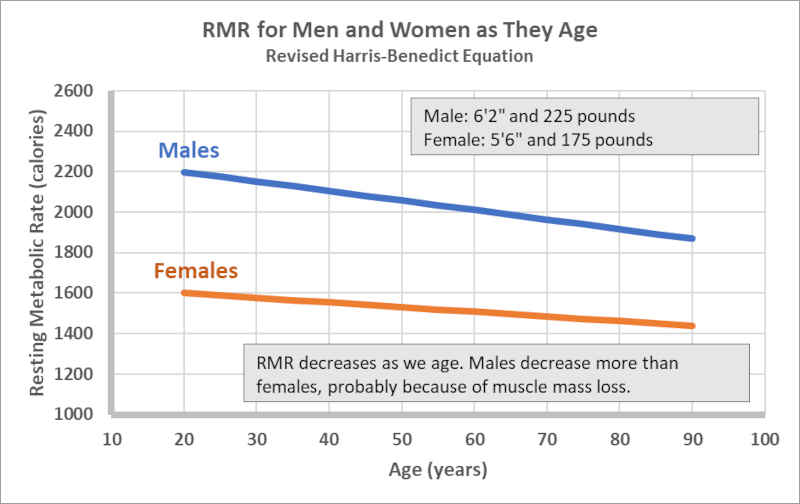
It turns out our RMR, or again, how many calories we burn at rest, decreases as we age. The following chart shows one line for men and one line for women. The RMR is shown on the vertical axis and age is shown on the horizontal axis. The man in this example weighs 225 pounds and the woman weights 175 pounds. Their heights are also different, as stated in the chart.
It’s pretty clear that each line slopes downward as we age – or in other words, our RMR decreases (we burn fewer calories at rest) as we age.
Interestingly, men’s RMR decreases a bit more with age than women’s. This is likely because at a healthy young age, men have more muscle mass than women. But both men and women tend to lose muscle as they age, but men lose more than women. Is this a significant decrease in RMR?
Notice that the age range in the chart is 20 years to 90 years old. For males, the RMR at 20 is 2,199 calories and at 90 it’s 1,870, a difference of 329 calories. Considering that’s over a 70-year period, that decrease amounts to less than 5 calories a year. That’s a very small number when it comes to calories (a banana, remember, has about 105 calories).
And in women, the difference is even less, 1,600 calories at 20 and 1,438 calories at 90 years old for a difference of 162 calories. Again, spread out over 70 years you won’t even notice the slightly more than 2 calories per year reduction in RMR.
How Much You Weigh Impacts Your RMR
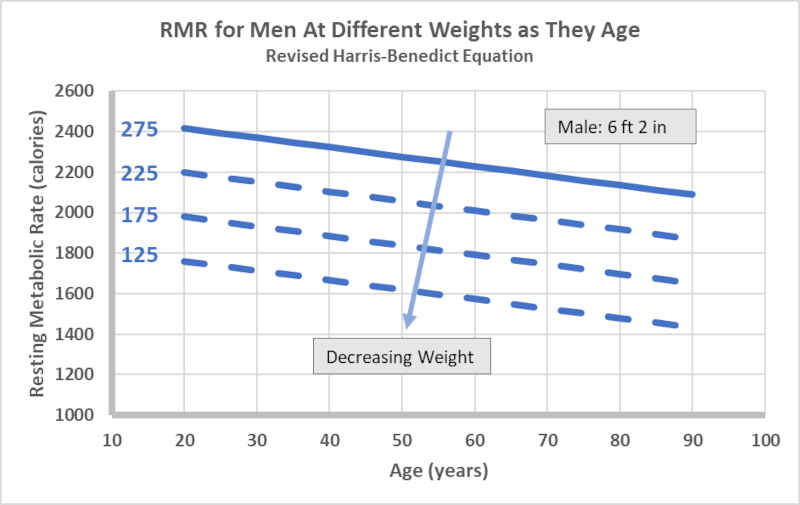
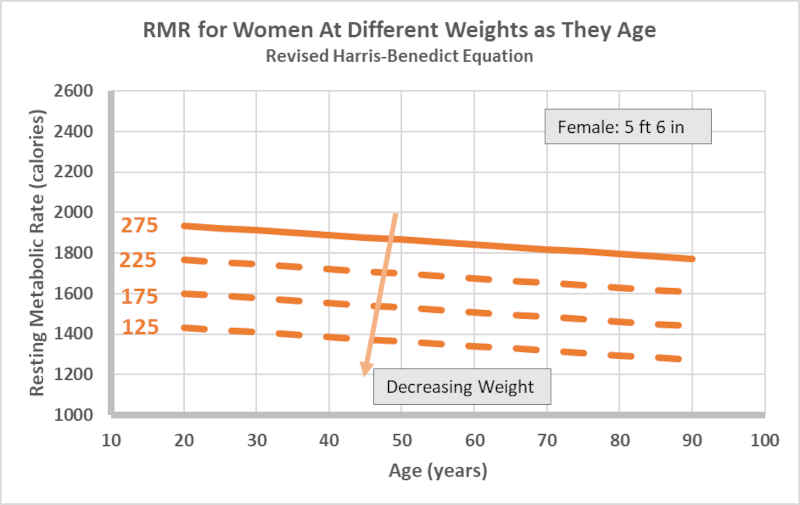
The following two graphs, one for a man and one for a woman, show RMR as a function of age, but at four different weights. Just like before, their age ranges from 20 to 90 years old. The weights range from a high of 275 pounds to a low of 125 pounds for both men and women. You can see that the line moves lower as your weight decreases. Again, this is a key pillar of weight loss science.
The reason is because the more weight you carry, the more work your body has to do to function at a resting state. Contrary to what you might read, fat mass also burns calories, albeit fewer than muscle mass. Your body has more to take care of. So, yes, it makes sense that your RMR increases as you gain weight. And that difference for men is about 500 calories for each 100 pounds, or 5 calories per pound. For women, it’s about 300 calories per 100 pounds, or about 3 calories per pound.
While this isn’t all that important right now, it does come into play as part of our weight loss strategy later on.
Now that you know how much energy you burn sitting around all day, let’s look at how much more you can burn with some physical activity.
Calories Burned During Physical Activity
Think about driving your car. You come upon a much slower car. After a while, you check for oncoming traffic and press the accelerator to pass the car. As you press the accelerator, your car speeds up. In other words, you’re asking your car to increase the work intensity by accelerating past the slow-moving car. As you press the accelerator, your car control system injects a higher rate of fuel into the engine.
Your body acts in much the same way. Let’s say you’re walking down the sidewalk. You notice a pair of geese sitting next to the sidewalk. As you approach, the geese become a little defensive. Not wanting to get beaten up by a pair of geese, you transition into a jog to get by them (or, if you’re my loving life partner, you might run in the other direction). In either case, you suddenly asked your body to increase your physical intensity – going from a leisurely walk to a jog (or run).
To support that increased physical intensity, your muscles burn fuel at a higher rate than when you were walking. It’s very similar to your car needing a higher fuel rate to pass that slow-moving car.
Key Points for Burning Calories
There are a couple of things we need to consider:
- As physical activity intensity increases (going from a walk to a run), your muscles need to consume (burn) fuel at a higher rate to achieve those higher intensities
- The fuel that those muscles burn are measured in terms of calories and comes in the form of glucose
- Glucose is stored in various forms (fat, glycogen, etc.) throughout your body and, when required, your body pulls it out of storage, converts it back into glucose, and adds it to your bloodstream
- Your bloodstream transports this glucose throughout your body
- Muscles pull glucose from the bloodstream and burn it to do work
- To provide glucose at a higher rate, your heart rate increases to move blood throughout your body at a higher rate
- Oxygen is also needed to burn glucose in the muscles. So, your breathing rate increases, too. Oxygen is transported throughout your body by, again, your bloodstream
A simpler way to say this is: your heart rate increases with physical activity intensity which means you burn calories at a higher rate. So, it seems that our heart rate can indicate how many calories we burn.
Research to Correlate Heart Rate to Calories Burned
A group of researchers conducted a study that correlated calories burned to heart rate. They published their results in the National Library of Medicine in the paper Prediction of energy expenditure from heart rate monitoring during submaximal exercise. The developed equations that correlate calories burned per hour to heart rate, age, weight, and sex are:
| Men | [0.6309×HR (beats per minute) + 0.1988×Weight (kg) + 0.2017×Age (years) - 55.0969] * 14.3403 |
| Women | [0.4472×HR (beats per minute) - 0.1263×Weight (kg) + 0.074×Age (years) - 20.4022] * 14.3403 |
The term HR is your heart rate. That’s how many beats a minute your heart is beating. The faster it beats, the more calories you burn.
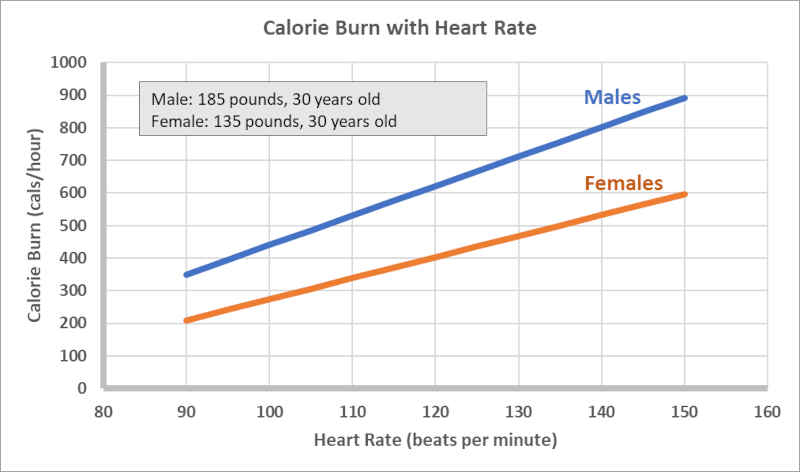
The authors of the study cautioned that these equations were only valid for heart rates between 90 and 150 beats per minute. You also have to remember that these are averages over many people, so don’t obsess over a few calories here and there. These correlations just aren’t that accurate for a given person, but they get us into the ballpark. That’s why I don’t recommend counting calories. But that’s for another post.
How Many Calories Do I Burn During Physical Activity?
The following graph shows how many calories the average human burns per hour over a range of heart rates. One line represents women and the other represents men. The graph clearly shows that higher heart rates during physical activity indicates you are burning more calories. And the range can be large, ranging from a low of 200-400 to a high of 600-900 calories per hour.
The take-away from this chart is that to burn a significant amount of calories, you MUST do an activity to get your heart rate to a higher value. However, if you’re more up for a moderate walk with a corresponding lower heart rate around 90 or 100 beats per minute and have the time, a two hour walk can burn about as many calories as a 1 hour run with a corresponding heart rate around 150 beats per minute.
Here’s a calculator that determines the burned calories per hour during physical activity:
Putting This All Together - Estimating Daily Calories Burned
Putting together the two ways we burn calories, we have the following equation to estimate our daily calorie burn:
Daily Cal Burn Rate = (24 – Physical Activity Hours) * RMR +
(Physical Activity Hours) * (Physical Activity Metabolic Rate)
Remember that the Physical Activity Metabolic Rate INCLUDES the RMR. Let’s explain this with a couple of examples.
Example 1: 185 Pound Male
Assume you have a desk job, but make time for an hour-long workout. You are 30 years old, weigh 185 pounds, stand 6 ft 2 inches tall, and are a male (I’ll do a second example for females). During the hour-long workout, your heart rate averages 100 beats per minute. That average includes rest between exercises.
The physical activity portion (using the PAMR calculator) is 441 calories for the one-hour of exercise.
The RMR calculation is slightly more complicated because the PAMR includes the RMR. Because we exercised for an hour, we need the RMR for only 23 hours (24 hours minus the 1 hour of exercise). Using the RMR calculator tells us that we burn 2006 calories burned per day (24 hours). We can correct that using the following equation:
RMRcorr = (24 – Exercise Hours)/24 * RMRdaily
For our example, that comes out to be 1,922 calories burned.
Now simply add the two numbers together:
Total Cals Burned = RMRcorr + PAMR = 1,922 + 441 = 2,363 calories burned.
If you rework this example with an average heart rate of 120 beats per minute, the total calorie burn for the day increases to 2,544 calories burned. That’s an increase of almost 200 calories. The lesson learned from that is when you commit to an hour of exercise, actually exercise to keep your heart rate up. I see people at the gym who do a specific exercise and then poke around on their phone for a couple of minutes before continuing. Their heart rate drops during “phone time” which decreases your overall average heart rate for the session.
Example 2: 135 Pound Female
Let’s do one more example for a female. We’ll keep most parameters the same, but lower the weight to 135 pounds and the height to 5 ft 6 inches.
RMRdaily = 1,443 cals burned per day. Then, corrected RMR is:
RMRcorr = (24 – 1)/24 * 1,443 = 1,383 cals burned
PAMR = 270 calories burned (from the calculator)
Total Cals Burned = 1,653 calories burned per day
As before, if we rest less during the workout and manage to average a heart rate of 120:
PAMR = 398
Total Cals Burned = 1,781 calories burned per day
Again, if you’re going to spend an hour exercising, then commit to that hour of exercise and limit your rest time. The payoff is about 130 calories each day. Thinking back to the 500 calorie deficit example at the beginning of this post, that 130 calories represents a quarter of your calorie deficit!
Next In Weight Loss Science - Storing Energy
Now that we understand how we burn calories and can estimate our personal calorie burn, let’s take a look at energy storage (and for most of us, the whole point of weight loss is to reduce the amount of energy we have stored in our bodies).
I’m still working on that one (COMING SOON!), but will have it in the next few days. If you want to be notified when the post is ready, submit the simple form below and I’ll send you an email when it’s posted! In the meantime, start figuring out how many calories you burn each day.
 Hi, I’m Kirby Chapman, the creator behind The Healthy League. You can read about