

This is the lengthening phase of a corrective exercise program designed to correct a forward head posture and rounded shoulders. Once you’ve done these exercises (static stretches) for at least two weeks, you can move to the activation phase of the corrective exercise program. That’s where you strengthen underactive muscles to pull the neck joint back into proper alignment. That’s not ready yet, but it will be in 2 weeks.

How to Do These Neck Stretches
These are static stretches for your neck that will begin to correct forward head posture. Doing these daily will improve neck mobility, offset the negative effects of looking down at a screen (phone, laptop computer), and alleviate pain. The key is to consistently do these stretches properly.
For each stretch, here is how you do them:
- Position your neck, head, and arms in the starting position.
- Move gently to the stretched position (this is the point where you feel some tension that may be uncomfortable but not to the point where the movement is painful).
- Hold the end position for 30 seconds (don’t fret over preciseness).
- Return to the starting position.
That’s it. Do this once a day for each stretch, and you should experience the following:
- You might feel a little sore the next day, but that means your body (muscle structure) is creating a desirable adaptation to do this possibly unfamiliar movement.
- Within a “few” days, you might notice an increased range of motion. If you couldn’t rotate your head to the side prior to this, you may notice some ability to rotate your head.
- The stretches will become easier.
After a couple weeks, you can add in a muscle activation exercise, but not now. I’ll have that ready soon.
Static Stretches to Correct Forward Head Posture
There are three muscles we have to lengthen. Fortunately, they can be done almost at the same time.
Starting Position: Standing upright, hold one arm to the side with your palm facing forward. Your feet are shoulder-width apart. You are looking straightforward.
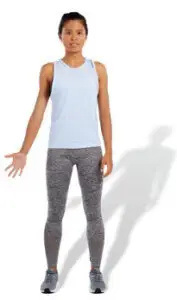
Stretch #1: With your other arm, reach to the top of your head and gently pull your head so that it bends toward that arm. Do not force any movement. Instead, pull until you feel some tension, maybe uncomfortable tension, but not pain. Hold for 30 seconds.
Continue directly into stretch #2.
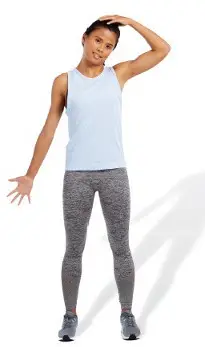
Stretch #2: Starting from the Stretch #1 position, gently rotate your head as if you were looking down at your hip as in the figure. Again, do not force any movement. Instead, rotate your head until you feel some tension, maybe uncomfortable tension, but not pain. Hold for 30 seconds.
Continue to Stretch #3.
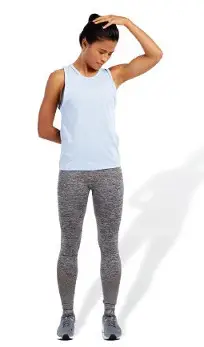
Stretch #3: Start from the Stretch #2 position and rotate your head so you are looking away from the arm that is assisting and slightly up. You will feel the stretch on the right side of your neck. And again, do not force the movement. Rotate as far as you can, but stop before you feel real pain. And again, a little discomfort is to be expected. Hold for 30 seconds.
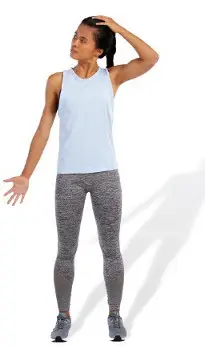
Now, repeat these three stretches for the other side of your body. Start with your other arm hanging down to your side with the palm facing forward and use the arm that was hanging to the side to gently position your head.
Do these daily, and you will feel relief from some neck pain. After a week or two of consistent effort, you will notice increased mobility in your neck. Just remember that your body will begin adapting to support the effort to return to a proper head posture. During this adaptation period, it’s common to feel some muscle aches. But they will only last for a couple of days.
IMPORTANT: But there’s one more thing – change how you use your phone and/or laptop computer so you’re not always looking down. I hold my phone up when I’m looking at it and I position my computer monitor so I’m looking straight at it. You should, too.
 Hi, I’m Kirby Chapman, the creator behind The Healthy League. You can read about