
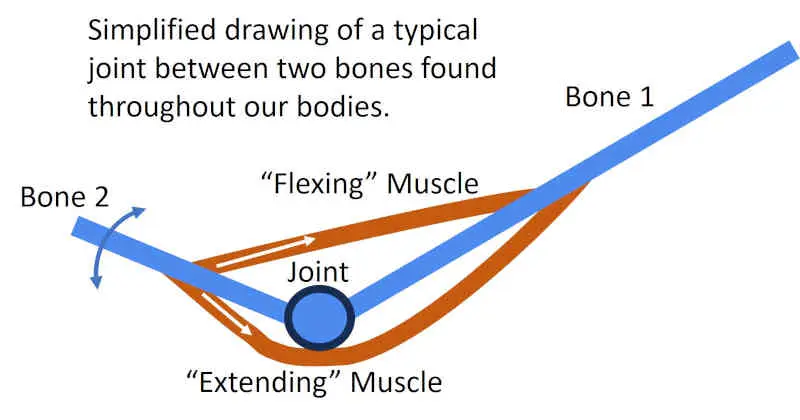
During life, we end up with common muscle imbalances throughout our body. These imbalanced muscles then pull on our joints to put them in a non-optimal position for everyday movement patterns. All you have to do is look at a few people around you – in Costco, at church, at the mall, or people who are apparently fit out for a walk or jog.
Unless we focus on maintaining optimal muscle balance, it’s bound to happen. It takes a bit of effort to keep our body working as an efficient movement machine. And after all, our bodies are meant to move.
This is a continually updated list of common muscle imbalances that ultimately affect the ease that you can move without aches and pains.
Forward Head Posture: One of the more Common Muscle Imbalances
The right side of the following image shows a person with normal (optimal) head posture. Now compare that posture to the one on the left. The person on the left suffers from Forward Head Posture, or FHP.
With optimal head posture, your ears are approximately above your shoulders and the upper back is not excessively rounded. It is natural to have a slight curve to the upper back as the spine approaches the neck.
If, as in the figure on the left, your ears are substantially in front of your shoulders and your upper back is rounded more than is natural, then you have forward head posture.
Forward head posture puts muscles in the front and back of your neck in non-optimal positions. It starts with looking down too much, as in looking at our phones or a laptop. At some point, you may notice that it takes some effort to straighten your head to look directly forward. It may even ache.
You’ve reached the point where some muscles are longer than they should be, and some are shorter than they should be. The shorter muscles become overactive and pull more than they should. The longer muscles become underactive and can no longer pull as they were intended to do.
Additionally, the upper portion of the spine at the back of your head, called the cervical spine, is in a position that compresses the vertebrae in the upper spine. This can cause headaches along with neck pain.
Over time, this poor postural position can begin to negatively impact your shoulders, arms, and even your hips. Further, the muscles and bones can degenerate in a negative way.
The good news is that this is all correctable. It just takes time.

Causes of Forward Head Posture
Forward head posture is a common muscle imbalance that happens slowly over time when we chronically look down at something. The “somethings” are typically a phone or computer screen.
When we spend a lot of time looking down, which is not an optimal postural position, some muscles become shorter than optimal and other muscles become longer than optimal.
Muscles Affected by Forward Head Posture
Three primary muscles are affected by FHP:
- Levator scapulae (shortened): these are smaller muscles that start at the top of your spine at the base of your skull and connect to the top of your shoulder blades. Because the back of your neck is “curved” more than it should be (refer to the figure above), these muscles become artificially shortened and continually pull on the base of your skull.
- Upper trapezius (shortened): This is the relatively large muscle in the back of the neck. It connects the top of the shoulder blade and rear portion of the collar bone to, again, your spine at the base of your skull. And just like above, the unnatural bend in the back of your neck shortens these muscles.
- Lower trapezius (lengthened): This is below the upper trapezius and still covers a large portion of your upper back. It stabilizes your shoulder blades and also pulls them down into a non-elevated position.
- Sternocleidomastoid (shortened): There’s a left and right muscle that connects your sternum and front portion of your collar bone to the back of your skull. Because you’ve held your head looking down for so long, these muscles become shorter and now continually pull down on your head.
Again, the good news is that our bodies adapt to what we ask them to do. In the case of FHP, we asked some to shorten and some to lengthen. That’s what I call an undesirable adaptation. Now we need to ask our bodies to create a desirable adaptation by returning these muscles to their optimal lengths.
Other Issues Created by Forward Head Posture
NASM describes several significant issues with FHP. But I summarize them here. These common muscle imbalances cause a variety of issues with our ability to move without pain:
- We can’t move through the full range of motion to look to the left or right, i.e., rotate our head.
- The upper part of our spine, called the cervical spine, becomes compressed leading to headaches and other pains (literally in the neck).
- Increased risk for early onset of degenerative changes in the upper (cervical) spine.
- Negatively influences the position and function of body structures above and below, like the respiratory system and the temporomandibular joint (the jawbone joint).
- Cause a chain reaction of dysfunction in the human movement system, i.e., shoulders, hips, knees, and ankles.
Hi, I’m Kirby Chapman, the creator behind The Healthy League. You can read about